

The Serve Return Problem: Why You Start Every Rally on Defense

Hey!
Last week, we covered the reset shot—when to stop attacking and why resetting from trouble is a tactical weapon, not a retreat.
This week, I want to share a pattern I’ve noticed throughout my teaching career.
I ask 3.0-3.5 players: “What’s the hardest part of your game?”
They list things like third-shot drops, dinking consistency, and transition timing.
Almost nobody mentions the serve return.
Then I watch them play.
And I see the same thing every match:
Their serve return lands short.
Their opponents step in. Take the ball early. Drive it back hard or drop it perfectly into the kitchen.
And suddenly they’re defending from the baseline—every single point.
The rally hasn’t even started, and they’re already on defense.
Not because their opponents served an ace. Because their return gave away court position.
Most 3.0-3.5 players don’t realize this is a problem.
They think the return is just “getting the ball back in play.”
It’s not.
The return is your first—and sometimes only—chance to take control of the rally.
Let me show you how.
The Serve Return Problem: Why You Start Every Rally on Defense
Here’s what happens on most serve returns at the 3.0-3.5 level.
The serve comes in.
You make solid contact. Get it back over the net. The ball lands somewhere in the court.
Good enough, right?
Then you look up.
Your opponents have already stepped forward. They’re taking the ball at chest height, four feet inside the baseline.
They drive it hard at your feet. Or drop it perfectly into the kitchen.
You’re scrambling. Defending. Reacting.
And the rally just started.
This happens point after point. Game after game.
You think the problem is your third shot or your transition.
The problem started with your return.
A short return gives your opponents time, space, and options.
A deep return pins them at the baseline, takes away their attack, and lets you control the rally.
One shot. Massive difference.
What 4.0 Players Do Differently
I’ve watched hundreds of 4.0 matches throughout my teaching career.
Here’s what I notice about their serve returns:
They land deep. Every time.
Not occasionally. Not when they “get a good one.”
Every. Single. Return.
The ball lands within three feet of the baseline—forcing opponents to hit from behind the court, taking away their drive option, giving the returner time to get set.
The specific thing 4.0 players do: They aim for depth first, placement second.
Most 3.0-3.5 players do the opposite.
They aim for the sideline. Or down the middle. Or at their opponent’s backhand.
But they don’t prioritize depth.
So the ball lands mid-court—six to eight feet inside the baseline.
That’s attackable territory.
4.0 players know something devastating:
A deep return to the middle is better than a short return to the corner.
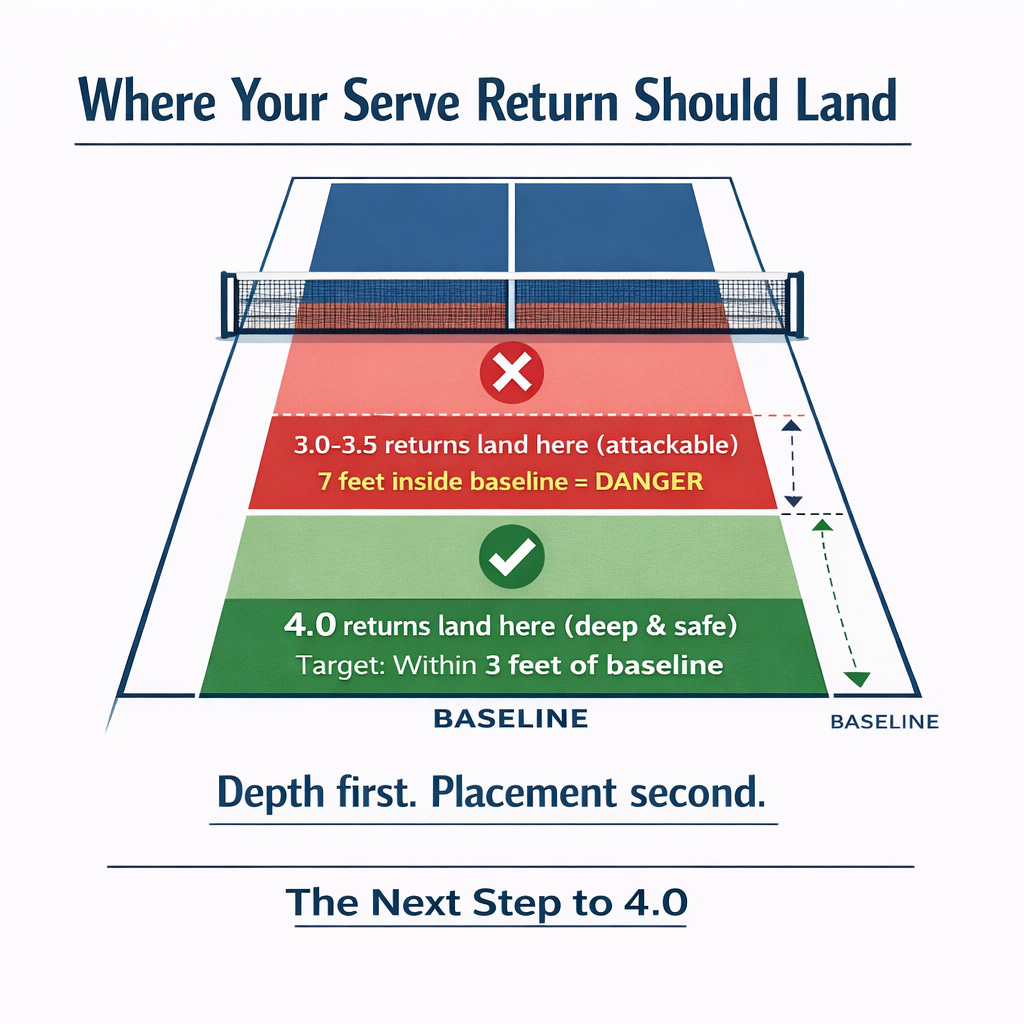
Depth removes options. Short balls create them.
Here’s the key insight: The serve return isn’t about winning the point immediately.
It’s about not losing court position before the rally even starts.
A deep return forces your opponents to earn their way to the kitchen—just like you have to.
A short return hands them the kitchen for free.
Why You’re Stuck on This
Last month, I watched a group of 3.5 players warm up before a tournament.
I tracked where their serve returns landed.
Average landing spot: Seven feet inside the baseline.
Then I asked them: “Where are you aiming your returns?”
Most of them said some version of: “At their backhand,” or “Down the line,” or “Away from them.”
Only two said: “Deep.”
There’s your problem.
You’re aiming for placement without prioritizing depth.
So you get good placement on a short ball, which gives your opponent a perfect setup to attack.
The other reason you’re stuck: You think depth requires power.
“If I hit it harder, it’ll go deeper.”
Not true.
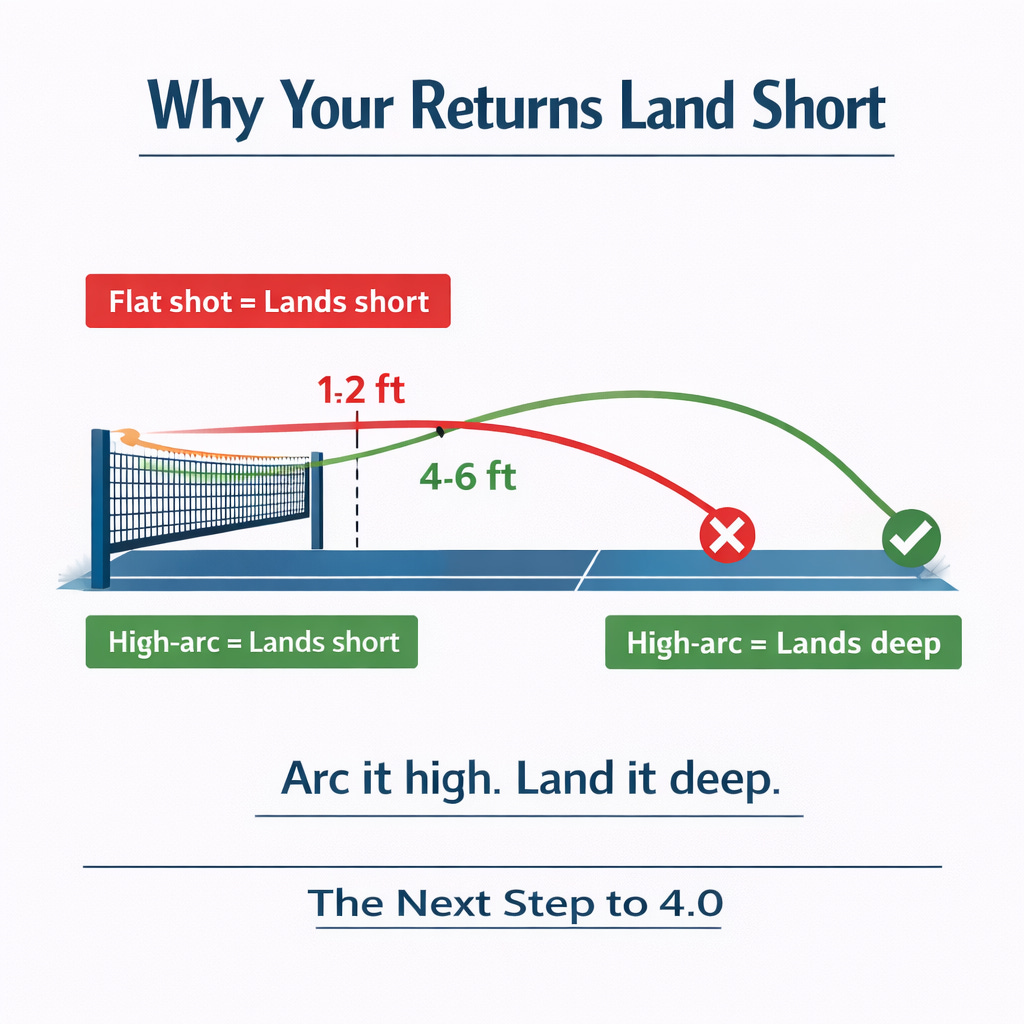
Depth comes from trajectory, not pace.
A high arc with moderate pace goes deep.
A flat shot with hard pace goes out or sits up mid-court.
Here’s the analogy that works for most players:
Think of a basketball free throw.
You don’t throw it harder to make it go farther. You arc it higher.
Same with your serve return. Arc over pace. Depth over power.
Your return should clear the net by 4-6 feet, not 1-2 feet.
That extra height creates the depth you need.
The Path Forward
Here’s what to focus on this week:
1. The Depth-First Target
Stop aiming for corners or sidelines.
Start aiming for one target only: deep.
The target zone: Within three feet of the baseline, anywhere across the court.
Middle is fine. Wide is fine. At their body is fine.
As long as it’s deep.
Once you can consistently land returns in that three-foot zone, then start adding placement.
But depth comes first.
Every time.
Most 3.0-3.5 players try to do both at once—depth AND placement—and end up with neither.
4.0 players master depth first. Placement follows.
The cue: “Deep first. Everything else second.”
2. The High Arc Technique
Here’s how to create depth without power:
Contact point: Slightly lower than usual (waist to belly button height works best)
Paddle face: Slightly open (not flat, not drastically open—just enough to lift)
Swing path: Low to high (brush up the back of the ball)
Target height over net: 4-6 feet (much higher than you think)
Follow-through: Up and out (finish high, not across your body)
This creates a rainbow trajectory—the ball clears the net high, peaks mid-court, then drops deep near the baseline.
Safe. Deep. Unattackable.
Most 3.0-3.5 players hit returns too flat. They aim for 1-2 feet of clearance over the net.
That’s why their returns land short.
Add height. The ball will go deeper.
The cue: “Arc it high, land it deep.”
3. The Two-Step Depth Check
After every serve return in practice, ask yourself two questions:
Question 1: “Did it land within three feet of the baseline?”
Yes: Good depth. Keep doing that.
No: Not deep enough. Add more arc.
Question 2: “Could my opponent step forward and take it early?”
Yes: Too short. They have time and space to attack.
No: Perfect. They’re pinned at the baseline.
Most players never evaluate their return depth.
They just hit it and move on.
Start paying attention to where it lands.
Your brain will adjust automatically once you’re tracking the right metric.
The cue: “Three feet from baseline—or add more arc.”
What Success Looks Like
You’ll know you’re getting this when:
Returns consistently land deep (within three feet of baseline)
Opponents stay back instead of stepping in
Third shots feel easier (because you’re not defending from the start)
You feel in control of rallies from the first shot
This takes two to three weeks of deliberate practice.
At first, adding height to your returns will feel wrong. You’ll think they’re going out.
They won’t.
Trust the arc. The ball will drop.
And here’s what surprised most of my students:
Once their returns started landing deep, their entire game improved.
Not because they practiced anything else.
Because they stopped starting every rally on defense.
Deep returns give you time. Time gives you options. Options let you win.
Reader Spotlight
A student of mine—Sarah, a 3.5 player from Boca Raton—came to me frustrated after losing a tournament.
“My third shots are terrible,” she said. “I keep getting attacked at the kitchen.”
I watched her play one match.
Her third shots were fine.
Her serve returns were the problem.
Every return landed six to eight feet inside the baseline.
Her opponents stepped in. Drove it hard. She scrambled from the baseline every point.
I asked her: “Where are you aiming your returns?”
“At their backhand,” she said.
“And how deep are they landing?”
She paused. “I... don’t know.”
We spent one session on depth-first returns. High arc. Three-foot target zone.
Two weeks later, she played the same tournament.
“I didn’t change anything else,” she told me. “Just made my returns land deeper.”
“And?”
“I won my match. The rallies felt completely different. I wasn’t defending anymore.”
She hadn’t improved her third shot. Hadn’t fixed her transition.
She’d just stopped giving away court position on the return.
That’s what one adjustment can do.
Working on something in your game? Reply and tell me about it—I’d love to feature your story here.
Next Sunday, we’ll tackle court coverage in doubles—specifically, why 3.0-3.5 partnerships leave gaps and how 4.0 teams move as a unit to cover the entire court.
See you then,
Bob
P.S. — Paid subscribers, check your inbox Thursday for three drills that train depth-first returns until landing deep becomes automatic. If you want to stop starting every rally on defense, upgrade here: https://thenextstepto4point0.substack.com/subscribe.
P.P.S. — I’ve been teaching this concept throughout my career, and the players who improve fastest are those who stop chasing perfect placement and start obsessing over depth. Depth wins at 3.0-3.5. Placement is a luxury you add later. Sound familiar?